If you are worried about a Hertz EV low battery fee, the most important thing to know is that there is not one clearly published nationwide charge universally described by Hertz under that exact name. Depending on your rental location and agreement, returning an electric vehicle with less charge than required may result in an EV Battery Recharge Fee or an Electric Vehicle Service Charge (EVSC).
Current Hertz US information is not completely uniform. Some Hertz pages still describe a fixed recharge fee, while newer location-specific rental terms calculate an EV Service Charge using the amount of battery charge missing at return. Always check the Rental Record issued for your specific vehicle before assuming what you will owe.
Is There a Hertz EV Low Battery Fee?
Hertz can charge a renter when an EV is returned with less battery charge than required under the applicable rental terms.
However, “low battery fee” is best understood as a general search term rather than necessarily the exact wording that will appear on your bill.
Hertz’s general US Rental Qualifications information currently states that renters should recharge an EV to the same battery level as when rented to avoid additional charges. Other current Hertz rental terms describe an EV Service Charge that can depend on how much charge is missing when the vehicle is returned.
Because official terms may differ by rental location, date, vehicle and agreement, your individual Rental Record should be treated as the most relevant source for your rental.
How Much Battery Should You Return a Hertz EV With?
Do not assume that every Hertz EV must be returned at exactly 80%.
Some current Hertz EV terms state that renters who have not purchased a charging option can avoid an EV Service Charge by returning the vehicle close to its pickup battery level. Certain terms also indicate that when a vehicle is provided with a high state of charge, renters may not be required to return it above a specified level.
The practical lesson is simple: record the battery percentage when you collect the vehicle and review the charging terms included with your Rental Record.
Example
Suppose your EV shows 68% when you leave the Hertz facility.
Do not automatically assume you must return it at 75%, 80% or 100%. Your actual requirement can depend on the charge level at pickup and the terms attached to that particular rental.
Likewise, a vehicle collected at a significantly higher charge level may have a different return requirement under the applicable agreement.
What Is the Hertz EV Service Charge?
The Electric Vehicle Service Charge, or EVSC, is a charging mechanism described in some current Hertz EV rental terms.
It may apply when you did not purchase an applicable charging option and return the vehicle without replacing enough of the battery charge used during the rental.
Depending on the agreement, the charge can be calculated using the difference between the vehicle’s battery level at pickup and return together with the applicable charging rate shown on the Rental Record.
That means renters should not assume there is one nationwide EVSC price.
Check the pricing and EV terms on your Rental Record before returning the vehicle.
What Is EVPO?
The Electric Vehicle Purchase Option, or EVPO, is an optional charging arrangement described in some Hertz EV rental terms.
It can allow qualifying renters to pay for battery charging under the terms provided at the beginning of the rental rather than following the normal self-recharging requirement.
Pricing and availability may vary according to location, vehicle, battery condition and the applicable rental terms.
If EVPO appears on your Rental Record and you are unsure why, review the optional products selected during reservation or pickup and ask Hertz through an official support channel if clarification is needed.
EVPO vs. EVSC vs. Charging Yourself
These options can be confusing because all of them relate to battery charge but work differently.
Charging yourself generally means bringing the vehicle back close enough to the required battery level under your agreement.
EVPO is an optional charging product available on some rentals.
EVSC may apply after return when the renter did not purchase an applicable charging option and did not recharge the vehicle sufficiently.
Charging the vehicle yourself before return may be less expensive in some situations, but actual costs depend on local charging rates, the rental agreement and the charging products available for that rental.
Do Not Confuse the Return Charge With Supercharger Costs
An EV-related amount appearing after a rental does not automatically mean Hertz charged you for returning the battery too low.
For compatible vehicles, including some Tesla rentals, charging sessions at supported charging networks may be billed through the rental account.
Some charging transactions may also appear after the initial rental receipt because processing can take place separately.
Another possible cost is an idle fee, which may occur when a vehicle remains connected to certain charging stations after charging has finished.
Before questioning an EV-related amount, identify exactly what type of charge appears on your receipt.
What Happens If the Battery Becomes Too Low While Driving?
A low return charge and an EV that can no longer be driven are different problems.
Renters are generally responsible for maintaining enough battery charge to safely reach a suitable charging location or the return facility.
If the EV becomes undrivable because its battery is depleted, towing or roadside-assistance costs may potentially apply under the rental terms.
If the vehicle is losing range unexpectedly, displays a serious warning or may not safely reach a charger, follow the instructions provided with your rental and use Hertz’s current official roadside-assistance method.
Do not rely on an independent third-party website to authorize a tow or make changes to a Hertz rental.
What to Do at Pickup
One of the easiest ways to reduce the chance of a battery-charge dispute is to document the vehicle before leaving.
Check the dashboard battery percentage while you are still at the rental location. Compare it with any charge level recorded on your Rental Record or pickup documentation.
If the figures do not match, ask the rental-location staff to clarify or correct the record before you drive away.
It is also sensible to take a clear photo of the dashboard showing the battery percentage. Keep your Rental Record and any pickup documents.
This can become important if a later charging calculation depends on the difference between the pickup and return battery levels.
What to Do at Return
Before handing the vehicle back:
- Check the EV return requirement in your Rental Record.
- Photograph the dashboard battery percentage.
- Keep evidence of your most recent charging session if relevant.
- Save the return receipt.
- Review the final invoice for EVSC, EVPO, charging, idle or other EV-related entries.
If staff are available and the recorded battery level appears incorrect, raise the issue before leaving the location whenever practical.
If You Were Charged Unexpectedly
Start by identifying the exact description on your rental receipt.
An amount labeled EVSC may have a different basis from a Supercharger charge, EVPO, idle fee, toll, towing cost or another post-rental adjustment.
Then compare:
- Battery percentage at pickup
- Battery percentage at return
- EV charging terms on your Rental Record
- Any EVPO selection
- Charging receipts
- Pickup and return photos
- Final rental receipt
If the numbers do not make sense, contact Hertz through an official support channel and explain the discrepancy clearly.
If the EV charge results in a billing adjustment or you are waiting for money to be returned, our guide to Hertz refund status explains what records to check and what to do when an expected refund has not appeared.
Avoid beginning with only “this fee is wrong.” A clearer request states the rental number, pickup charge level, return charge level, amount charged and why your documentation appears inconsistent.
Which Hertz Support Channel Should You Use?
The best channel depends on when the problem occurs.
Rental Counter
The rental location is generally the best first option when the issue is visible during pickup or return.
Examples include an incorrect battery reading, a charging option you did not expect, a vehicle problem discovered before leaving or disagreement over the recorded return battery level.
Resolving a factual discrepancy before leaving can make a later billing review easier.
Roadside Assistance
Use the official roadside-assistance information included with your rental when the EV cannot be driven safely, is stranded because of insufficient charge or develops a vehicle problem during the rental.
Always use the current official Hertz instructions provided with your rental or through Hertz’s official website or app.
Customer Service or Online Support
General customer service is usually more appropriate when you discover an EVSC or another billing issue after receiving the final receipt.
Use Hertz’s official website or app to find current contact options rather than relying on an old phone number published by a third-party website.
Reservation Support
A battery-return dispute is normally a completed-rental issue rather than a reservation issue.
Reservation support is more suitable for questions about upcoming bookings, vehicle availability, optional products or booking changes before pickup.
Social Media
Official social channels may help route a general question, but avoid posting rental numbers, payment information, addresses or other personal details publicly.
For billing disputes, use a private official support method.
What to Prepare Before Contacting Hertz
A clear support request is easier to review when the relevant information is together.
Prepare:
- Reservation or Rental Agreement number
- Full name shown on the rental
- Pickup and return locations
- Pickup and return dates
- Vehicle details
- Battery level at pickup
- Battery level at return
- Final receipt
- Relevant charging receipts
- Dashboard photos
- Payment method used
- Exact name and amount of the disputed charge
- A short explanation of what appears incorrect
Do not send complete card numbers or other sensitive financial information through a public or insecure channel.
If the Pickup Battery Reading Was Wrong
This is one of the most important situations to document.
Imagine the rental documentation states that the vehicle left with 80% charge, but the dashboard actually showed 62%.
If a later charging calculation uses the higher starting figure, that difference could matter.
A photo taken at pickup gives you clearer evidence when asking Hertz to review what was recorded.
Ideally, ask the rental-location staff to correct the discrepancy before leaving rather than relying entirely on a later billing dispute.
If the Return Battery Reading Looks Wrong
Take a dashboard photo shortly before handing back the vehicle.
Keep the photo together with your rental receipt and relevant charging records.
Then compare the percentage shown in your evidence with any battery calculation or EV-related charge appearing on your final paperwork.
Do not assume that every difference automatically means the charge is incorrect because some rental terms may calculate charging costs using battery energy, applicable rates or other conditions rather than simply charging a fixed amount per percentage point.
Current Hertz Pages May Describe EV Charges Differently
This is worth emphasizing.
Different Hertz US pages and location-specific rental terms may describe EV charging costs differently.
One page may refer to an EV Battery Recharge Fee, while other rental terms may describe EVPO and EVSC calculations.
Therefore, it would be misleading to tell every US renter that the Hertz EV low battery fee is always one fixed amount.
Your rental location, Rental Record, membership status where applicable, booking terms, vehicle and rental date can affect what rules apply.
Always verify important charging requirements against your specific Rental Record and the current information on Hertz’s official website or app.
How to Reduce the Risk of an EV Charging Dispute
Before collecting the vehicle, read the EV section of your agreement rather than assuming electric-car returns work exactly like gasoline rentals.
At pickup, photograph the battery level.
Before returning the vehicle, check the applicable return requirement and decide whether recharging the vehicle yourself makes sense.
If your plans change and you need to keep the EV beyond the scheduled return time, read our guide on how to extend a Hertz rental before simply keeping the vehicle longer. An extension should be confirmed through the appropriate Hertz channel before the original return time.
At return, photograph the battery again and keep the final receipt.
These simple records can make it much easier to explain what happened if you later need a billing review.
Bottom Line
The term Hertz EV low battery fee does not necessarily refer to one simple nationwide charge.
Depending on the Hertz terms applicable to your reservation, returning an EV below the required battery level may result in an EV Battery Recharge Fee, an EV Service Charge or another charging-related amount.
Most importantly, check your individual Rental Record before returning the vehicle. It contains the terms most relevant to your location, vehicle and booking.
If an EV-related charge appears incorrect, document the pickup and return battery levels, keep charging receipts and contact Hertz through its current official website or app.
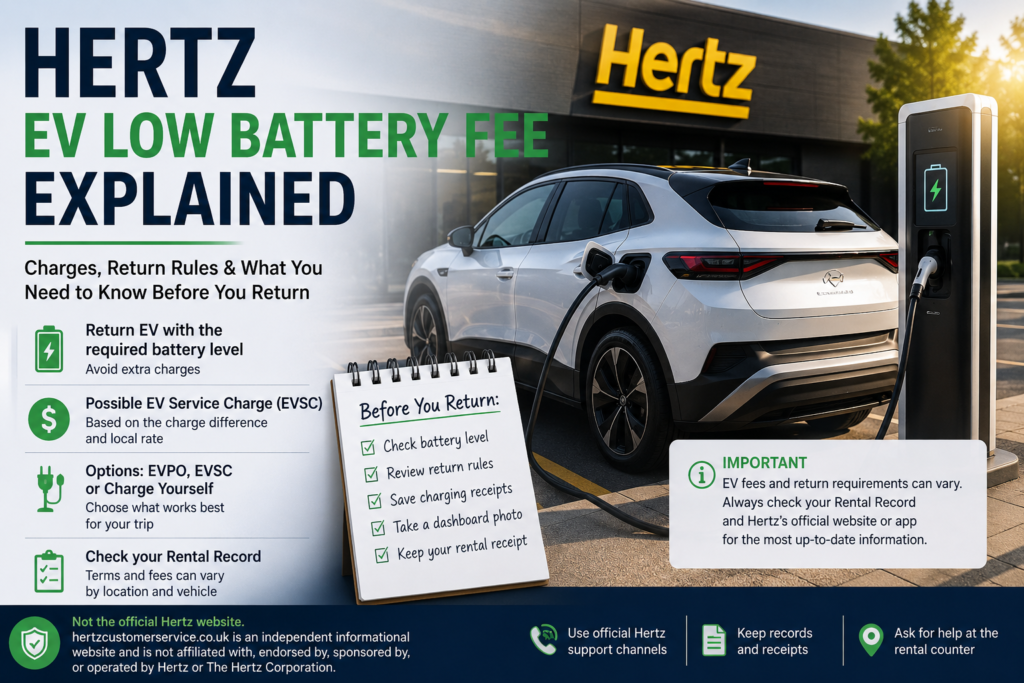
hertzcustomerservice.co.uk is an independent informational website and is not affiliated with, endorsed by, sponsored by, or operated by Hertz or The Hertz Corporation.
FAQs
Does Hertz charge a low battery fee for EV rentals?
Hertz may charge renters who return an EV with less battery charge than required under their rental terms. The amount may be described as an EV Battery Recharge Fee, EV Service Charge or another EV-related charge rather than specifically as a “low battery fee.”
How much charge should a Hertz EV have when I return it?
The required battery level can depend on the vehicle’s charge at pickup and the terms attached to your rental. Check your Rental Record instead of assuming every Hertz EV must be returned at a fixed percentage.
Is the Hertz EV recharge fee always the same amount?
No. Hertz policies and location-specific rental terms may describe EV charging charges differently. Check the pricing and charging conditions on your specific Rental Record.
What is Hertz EVSC?
EVSC means Electric Vehicle Service Charge. Under some Hertz rental terms, it can apply when an EV is returned without enough replacement charge and the renter did not select another applicable charging option.
Can I return a Hertz EV without charging it?
It may be possible depending on the charging option selected for your rental. However, returning below the required battery level without an applicable charging option may result in an additional charge.
What happens if my Hertz EV runs out of battery?
If an EV becomes undrivable because its battery is depleted, roadside assistance or towing may be required and additional costs can potentially apply. Follow the official roadside-assistance instructions included with your rental.
What should I do if my Hertz EV charge looks wrong?
Compare your Rental Record, final receipt, pickup and return battery levels, photographs and charging receipts. If the information appears inconsistent, contact Hertz through an official support channel and request a review.